
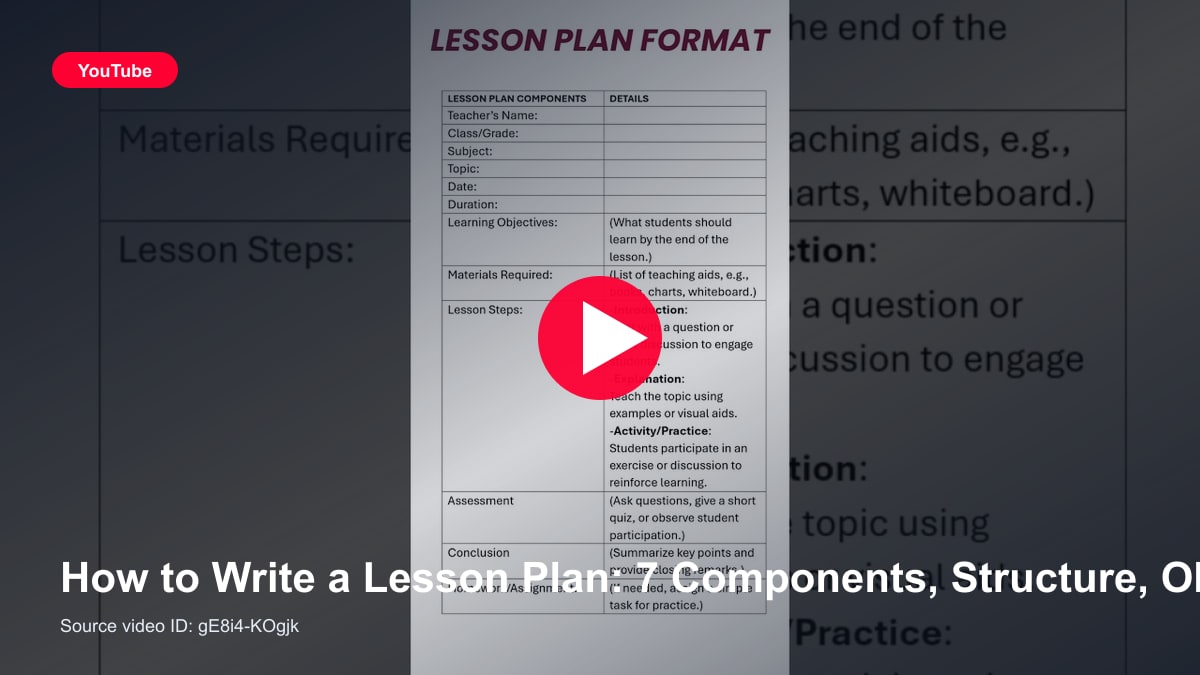
A lesson plan is a structured document that defines what students need to learn, how the teacher will deliver that learning, and how progress will be measured. According to the University of Michigan’s Center for Research on Learning and Teaching (CRLT), a successful lesson plan integrates 3 key components: learning objectives, teaching and learning activities, and assessment of student understanding. Lessons with clearly defined objectives see 25% higher retention rates than lessons without them, according to TeachThought research.
What Is a Lesson Plan?
A lesson plan is the teacher’s roadmap for a single class session. It translates broad curriculum goals into specific, time-bound activities with defined outcomes. A lesson plan is written before the class takes place, not during it. It covers what students will learn, what the teacher will do, what materials are needed, and how understanding will be checked.
Lesson planning is a central activity of teaching. A 2025 scoping review published in Cogent Education, covering 37 empirical studies on lesson planning in teacher education, found that alignment to evidence-based planning practices produces consistently stronger instructional outcomes.
What Are the 7 Components of a Lesson Plan?
A complete lesson plan contains 7 components. These are consistent across primary, secondary, and higher education contexts.
- Learning objectives
- Required materials and resources
- Introduction or hook
- Instructional activities
- Formative assessment
- Closure
- Reflection notes
Each component serves a distinct purpose. Removing any one of them weakens the plan’s ability to guide instruction and measure outcomes.
How Do You Write Learning Objectives for a Lesson Plan?
Write learning objectives as specific, measurable, student-centred statements that describe what students will be able to do by the end of the lesson. Begin every objective with “Students will be able to…” followed by an observable action verb.
Research published by SchoolAI in 2025 confirms that making learning goals explicit leads to better student performance and motivation. Objectives written in vague terms (“Students will understand photosynthesis”) cannot be measured. Objectives written in observable terms (“Students will label the 4 stages of photosynthesis on a diagram with 80% accuracy”) can.
What Is the SMART Framework for Lesson Objectives?
SMART objectives are the standard format for writing measurable lesson outcomes. SMART stands for:
| Letter | Meaning | Example Application | |—|—|—| | S | Specific | Targets one skill or concept only | | M | Measurable | Uses a verb that produces observable evidence | | A | Achievable | Appropriate to the students’ current level | | R | Relevant | Aligned to curriculum standards | | T | Time-bound | Achievable within the lesson period |
What Are Bloom’s Taxonomy Verbs for Lesson Objectives?
Bloom’s Taxonomy organises cognitive skills into 6 levels, each with recommended action verbs for writing objectives:
- Remember: define, list, recall, identify, name
- Understand: explain, summarise, describe, classify, compare
- Apply: solve, demonstrate, use, calculate, construct
- Analyse: examine, differentiate, organise, distinguish, break down
- Evaluate: judge, justify, critique, assess, defend
- Create: design, compose, develop, produce, formulate
Educational research indicates that providing opportunities to practise higher-order thinking (levels 4, 5, and 6) improves student achievement, including for struggling learners. Lesson objectives should not always target the lower 2 levels.
How Do You Write the Introduction Section of a Lesson Plan?
Write the introduction as a hook that activates prior knowledge and captures student attention in the first 5 to 10 minutes. Research from Discovery Education confirms that students who feel positive at the beginning of a lesson show higher motivation and confidence throughout it.
There are 4 effective hook formats:
- A short video clip related to the lesson topic
- A provocative question that connects the topic to the student’s experience
- A quick hands-on activity or demonstration
- A brief review quiz covering the prior lesson’s content
The introduction section of the lesson plan should also include 3 diagnostic questions the teacher asks internally before planning activities:
- What do students already know about this topic?
- What misconceptions are common?
- What prior lesson content does this build on?
How Do You Write Instructional Activities in a Lesson Plan?
Write instructional activities as a time-sequenced list of what the teacher does and what students do, with approximate durations for each segment. Activities must align directly with the learning objectives. An activity that does not help students meet an objective does not belong in the plan.
What Are the Best Instructional Activity Formats?
There are 5 research-supported instructional activity formats used in lesson planning:
- Direct instruction: Teacher explains the concept with examples. Best for introducing new content.
- Think-Pair-Share: Students think independently, discuss with a partner, then share with the class. Builds verbal reasoning and checks understanding quickly.
- Jigsaw: Students become experts on one aspect of a topic and teach it to peers. Develops accountability and deep processing.
- Problem-solving tasks: Students apply a concept to a new scenario. Targets the Apply and Analyse levels of Bloom’s Taxonomy.
- Journaling or written reflection: Students write responses to prompts or solve problems in writing. Useful for formative data and for students who are reluctant to speak aloud.
How Do You Time Activities in a Lesson Plan?
Divide the lesson into 3 phases with approximate time allocations:
| Phase | Content | Suggested Time Allocation | |—|—|—| | Opening | Hook, prior knowledge activation | 10% of total lesson time | | Core instruction | Direct teaching + student activities | 70% of total lesson time | | Closure | Summary, assessment, reflection | 20% of total lesson time |
For a 60-minute lesson, this produces 6 minutes for the opening, 42 minutes for core instruction, and 12 minutes for closure.
What Is Formative Assessment in a Lesson Plan?
Formative assessment in a lesson plan is a check for understanding that happens during the lesson, not at the end. It gives the teacher real-time information about whether students are on track. It is not graded.
There are 5 quick formative assessment methods to include in a lesson plan:
- Exit ticket: Students write one thing they learned and one question they still have, submitted at the end of the lesson
- Mini whiteboard responses: Students write answers and hold them up simultaneously so the teacher can scan all responses at once
- Traffic light check: Students indicate understanding with green (got it), yellow (mostly), or red (not yet)
- Cold calling with wait time: The teacher poses a question, allows 30 seconds of thinking time, then selects a student to answer
- Pair sharing: Students explain the concept to a partner while the teacher circulates and listens
A IES Regional Educational Laboratory Pacific report found that lesson plans incorporating formative checkpoints consistently produced stronger student outcomes than plans focused solely on end-of-lesson summative assessment.
How Do You Write the Closure Section of a Lesson Plan?
Write the closure section as a planned 5 to 10 minute activity that consolidates learning and connects it to what comes next. Closure is not “pack away your things.” It is a deliberate instructional move that helps students organise what they have just learned.
There are 3 closure formats used in effective lesson plans:
- Summarise and connect: The teacher or students summarise the lesson’s key points and the teacher states how it connects to the next lesson
- Exit ticket: Students respond to a prompt that directly tests one of the lesson’s learning objectives
- 3-2-1 reflection: Students write 3 things they learned, 2 things they found interesting, and 1 question they still have
The closure section of the lesson plan should always reference the learning objectives from the opening. If the objectives were stated to students at the start, revisiting them at the end is an established technique for improving retention.
How Do You Write the Reflection Section of a Lesson Plan?
Write the reflection section after the lesson has been taught, not before. It is a brief note of what worked, what did not, and what to adjust next time. This section is for the teacher’s own professional development.
There are 4 questions a reflection section should answer:
- Did students achieve the learning objectives? What is the evidence?
- Which activities were most effective at engaging students?
- What would you change about the timing or sequence?
- What does the formative assessment data indicate about what needs to be revisited?
What Does a Complete Lesson Plan Look Like?
The template below shows the full structure of a lesson plan for a 60-minute session.
| Section | Content | |—|—| | Subject | Year 9 Biology | | Topic | Cell Division: Mitosis | | Duration | 60 minutes | | Learning Objective | Students will be able to sequence the 4 phases of mitosis in the correct order with 80% accuracy | | Materials | Whiteboard, mitosis diagram handout, coloured pencils, exit ticket slips | | Introduction (6 min) | Show a 2-minute time-lapse video of cell division. Ask: “What do you think is happening in this video and why?” | | Core Instruction (42 min) | 10 min: Teacher explains each phase with labelled diagrams. 15 min: Students label and colour their own diagrams in pairs. 17 min: Students sequence cut-out phase cards in the correct order and justify each step to a partner | | Formative Check | Teacher circulates during pair work and listens to justifications. Traffic light check at the 40-minute mark | | Closure (12 min) | Students complete exit ticket: sequence the 4 phases and write one sentence explaining what happens in each | | Reflection (after class) | Were the exit tickets correct? Which phase caused the most confusion? Does the next lesson need to revisit any phase? |
What Are the Most Common Lesson Plan Mistakes?
There are 5 mistakes that consistently weaken lesson plans:
- Vague objectives: “Students will learn about fractions” cannot be assessed. Rewrite with an observable verb and a measurable standard.
- Activities that do not match objectives: An objective targeting analysis-level thinking paired with a memory recall activity is misaligned.
- No formative checkpoint: A plan that only assesses at the end gives the teacher no opportunity to adjust during the lesson.
- Overloaded content: Research consistently shows that covering fewer topics in greater depth produces better retention than covering many topics superficially.
- No closure: Ending a lesson by running out of time is not closure. Plan the closure first and protect the time for it.
A structured lesson plan does not restrict teaching. It eliminates the cognitive load of deciding what to do next so the teacher can focus entirely on how students are responding.
For another writing guide, see How to Write an Invitation Letter: Format, Types, Components, and Examples.
