
An invitation letter is a written request asking a specific person or group to attend an event, meeting, celebration, or formal occasion. It provides the recipient with the event’s purpose, date, time, venue, and RSVP instructions in clear, appropriately toned language. There are 2 primary types: formal invitation letters for professional or official occasions, and informal invitation letters for personal or social gatherings.
What Is the Purpose of an Invitation Letter?
The primary purpose of an invitation letter is to inform the recipient that their presence is expected or desired and give them all information needed to attend. A secondary purpose is to help the host estimate the number of attendees by requesting an RSVP response by a specific date.
Invitation letters differ from verbal invitations in 3 important ways:
- They provide a written record of all event details the recipient can reference
- They signal the significance of the event through their formality or personal warmth
- They set the recipient’s expectations about the event’s tone and dress requirements before arrival
What Are the Types of Invitation Letters?
There are 3 main types of invitation letters, each suited to a different occasion and relationship:
| Type | Occasion | Tone | Person Used | |—|—|—|—| | Formal invitation letter | Corporate events, graduations, official ceremonies, conferences | Professional, structured | Third person or first person plural (We) | | Informal invitation letter | Birthdays, weddings, family gatherings, casual dinners | Warm, conversational | First person (I or We) | | Semi-formal invitation letter | Staff events, community meetings, school functions | Polite but relaxed | First person plural (We) |
The choice of type determines the language, structure, and level of detail in the letter. Using a formal tone for a casual birthday party feels cold. Using an informal tone for a corporate conference feels unprofessional.
What Are the Components of a Formal Invitation Letter?
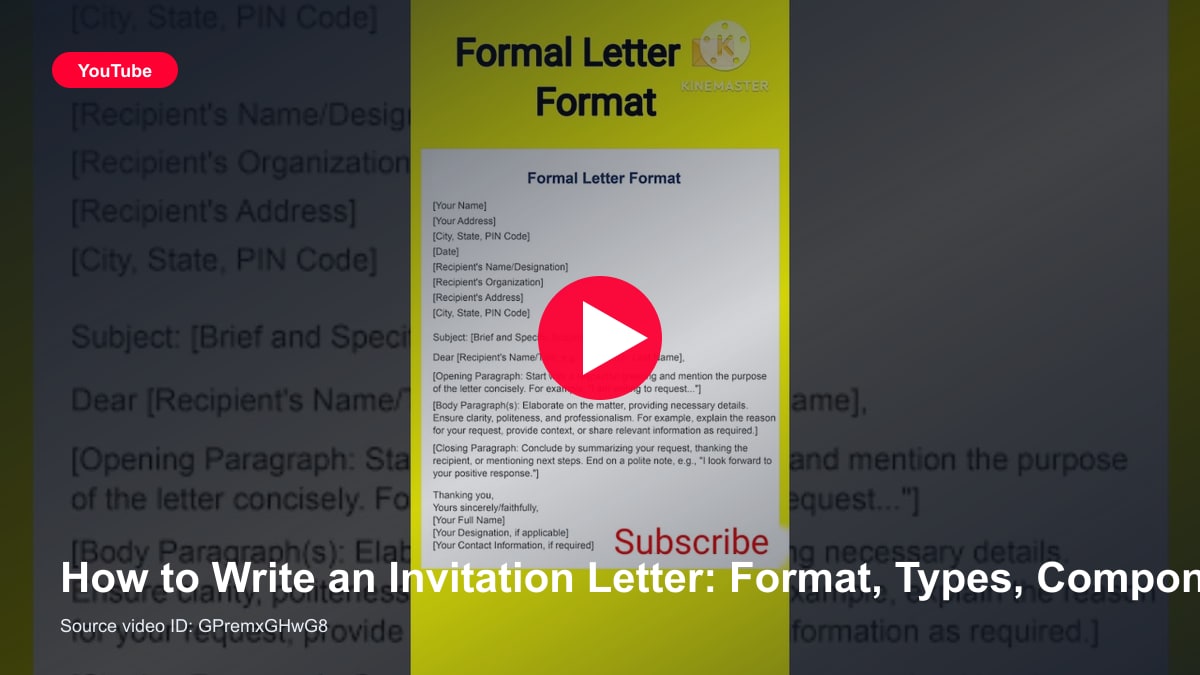
A formal invitation letter contains 8 components:
- Sender’s name, title, and organisation
- Date the letter is written
- Recipient’s name, title, and address
- Subject line (for business letters)
- Formal salutation
- Body: purpose, event details, and reason for inviting the recipient
- RSVP request with deadline and contact details
- Formal closing and signature
Every component serves a function. Removing the RSVP section leaves the host without confirmation data. Removing the subject line in a business invitation forces the recipient to read the full letter before understanding its purpose.
How Do You Write a Formal Invitation Letter Step by Step?
Step 1: Write the Sender’s Information
Place your full name, title, organisation name, and contact details at the top left of the letter. This tells the recipient immediately who the invitation is from and how to respond.
Step 2: Add the Date
Write the date the letter is sent directly below the sender’s information. Use a full written format. Examples include: 10 July 2026 or July 10, 2026. Do not use numeric-only formats such as 10/07/26 in formal correspondence, as they create ambiguity across regional date conventions.
Step 3: Add the Recipient’s Information
Write the recipient’s full name, title, and address below the date. For a formal letter addressed to a known individual, use “Dear Mr. [Surname]” or “Dear Dr. [Surname].” Use “Dear Sir/Madam” only when the recipient’s name is unknown.
Step 4: Write the Subject Line
Include a subject line that names the event directly. Examples:
- Subject: Invitation to the Annual Business Summit – 10 August 2026
- Subject: Invitation to Deliver a Keynote Address – International Science Conference 2026
Step 5: Write the Body
The body of a formal invitation letter has 3 parts:
- Introduction: State that you are writing to invite the recipient and name the event
- Event details: Provide the date, time, venue, and purpose of the event
- Personalised reason: Explain specifically why the recipient is being invited and what their role or value at the event is
Step 6: Add the RSVP Request
State the RSVP deadline and provide the contact method. The RSVP section is placed before the closing. Example: “Kindly confirm your attendance by 25 July 2026 by contacting us at events@organisation.com or +1 212 000 0000.”
Step 7: Close the Letter
Use a formal closing. Standard options include: “Yours sincerely,” “Yours faithfully,” or “Respectfully yours.” Sign with your full name and title below the closing.
What Does a Formal Invitation Letter Look Like?
Sample: Corporate Event Invitation
XYZ Corporation 123 Business Avenue, New York, NY 10001 Email: events@xyzcorp.com Date: July 10, 2026
Mr. James Okafor Managing Director Okafor & Partners LLC 45 Commerce Street, Chicago, IL 60601
Subject: Invitation to the Annual Business Summit – 10 August 2026
Dear Mr. Okafor,
We are pleased to invite you to the XYZ Corporation Annual Business Summit 2026, to be held on Monday, 10 August 2026, at the Grand Hyatt Hotel, New York, from 9:00 AM to 4:00 PM.
The summit will feature keynote addresses by industry leaders, panel discussions on emerging market trends, and structured networking sessions. Given your extensive work in supply chain innovation, your perspective would add significant value to the panel discussion scheduled for 11:00 AM.
We would be honoured by your participation. Kindly confirm your attendance by 25 July 2026 by contacting our events team at events@xyzcorp.com or +1 212 000 0000.
We look forward to welcoming you.
Yours sincerely,
Sarah Mitchell Director of Corporate Events XYZ Corporation
How Do You Write an Informal Invitation Letter?
An informal invitation letter follows the structure of a personal letter. It uses the first person, a warm salutation using the recipient’s first name, and conversational language. Contractions are acceptable. The tone reflects the personal relationship between sender and recipient.
What Are the Components of an Informal Invitation Letter?
An informal invitation letter contains 6 components:
- Sender’s address and date
- Personal salutation (Dear [First Name],)
- Opening: a warm greeting or reference to the relationship
- Event details: date, time, venue, and what to expect
- Personal reason why the recipient’s presence matters
- Friendly closing and first name signature
What Does an Informal Invitation Letter Look Like?
Sample: Birthday Party Invitation
14 Elmwood Close Lagos, Nigeria July 10, 2026
Dear Chisom,
I hope you are doing well. I am writing to invite you to my daughter Adaeze’s 5th birthday party, which we are hosting on Saturday, 25 July 2026, at our home from 2:00 PM to 6:00 PM.
We are planning a small gathering with close friends and family, and Adaeze has specifically asked that you be there. There will be games, food, and a cake, so please come ready to celebrate.
Do let me know by 18 July if you are able to make it so I can finalise the arrangements. You can reach me on 0801 234 5678 or reply to this note.
Looking forward to seeing you.
With warm regards, Ngozi
How Do Formal and Informal Invitation Letters Differ?
| Feature | Formal | Informal | |—|—|—| | Tone | Professional, structured | Warm, conversational | | Salutation | Dear Mr./Dr./Sir/Madam | Dear [First Name] | | Person | Third person or We | I or We | | Contractions | Not used | Acceptable | | Subject line | Required | Not required | | Closing | Yours sincerely / Yours faithfully | With warm regards / Best wishes | | Length | Longer, comprehensive | Shorter, personal | | RSVP format | Formal deadline with contact details | Casual request with phone or message |
The most common error when writing a formal invitation is using contractions. Do not write “We’re pleased to invite you.” Write “We are pleased to invite you.” Contractions reduce perceived formality in business correspondence.
What Must Every Invitation Letter Include?
Regardless of type, every invitation letter must answer 5 core questions:
- Who is inviting the recipient and who is hosting the event?
- What is the event and what is its purpose?
- When does the event take place, including start and end time?
- Where is the event being held, with a full address?
- How should the recipient confirm attendance and by what date?
These are the minimum details a recipient needs to decide whether to attend and make the necessary arrangements. Missing any of these forces the recipient to follow up, which delays planning and reduces response rates.
What Are the Most Common Invitation Letter Mistakes?
There are 6 mistakes that consistently weaken invitation letters:
- Omitting the RSVP deadline: Without a deadline, recipients delay confirming and the host cannot plan
- Using the wrong tone for the event type: A casual tone in a corporate event invitation reduces perceived professionalism
- Burying the event date: The date should appear early in the body, not in the third paragraph
- Not personalising the recipient’s reason for being invited: Generic invitations feel mass-produced and reduce engagement
- Using contractions in formal letters: “We’re” and “I’d” are not appropriate in formal correspondence
- No contact information: If the recipient has a question or cannot attend, they need a clear way to respond
An invitation letter sets the tone for the event before the event takes place. A well-written letter signals that the event is organised, that the recipient’s attendance is genuinely valued, and that the host has the details under control.
For another writing guide, see How to Write a Guarantor Letter: Format, Components, Types, and Examples.
