
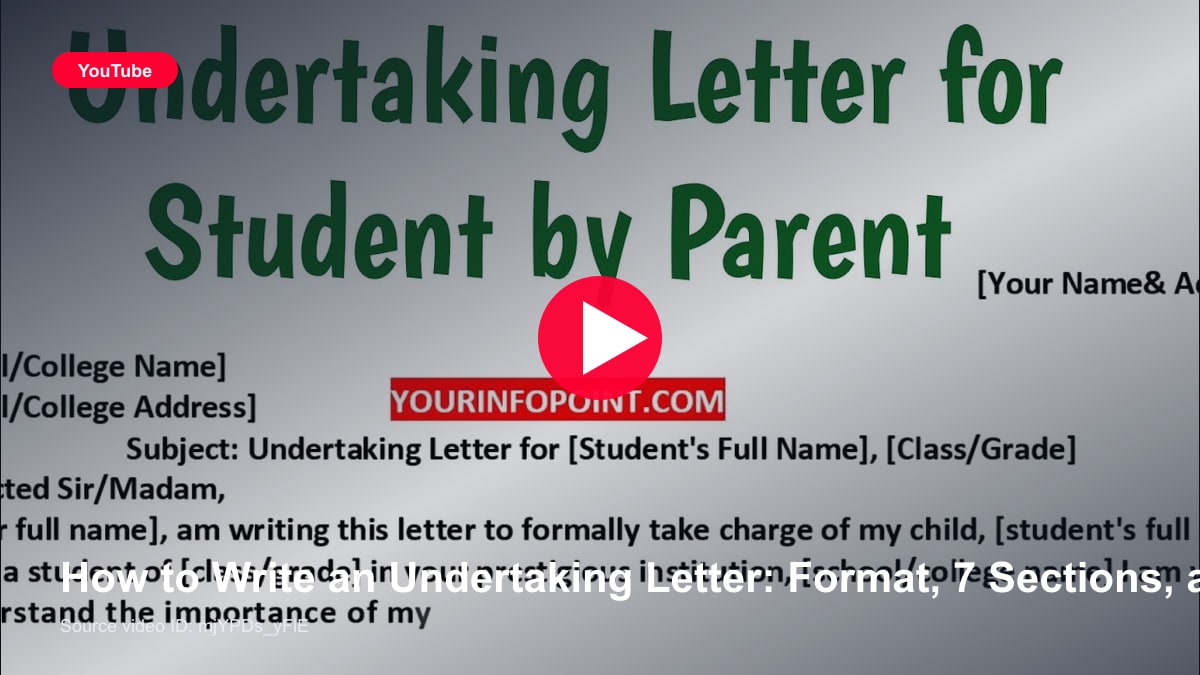
An undertaking letter is a formal written document in which one party commits to fulfilling specific obligations to another party. It is not always a legally binding contract, but when signed by all parties, it serves as an enforceable written promise. <cite index=”13-1″>For an undertaking letter to be valid, all parties involved must accept the terms of the letter, else the agreement becomes void.</cite>
What Is an Undertaking Letter?
<cite index=”13-1″>An undertaking letter is a formal document that provides assurance from one party to another to fulfill an obligation. It is mostly used from a business perspective to fulfill agreed deeds or work and is usually brief and clear, unambiguously explaining the sender’s intent.</cite>
It differs from a contract in 1 key way. A contract is always legally binding from the point of signing. An undertaking letter is binding only when it meets specific legal criteria, including acceptance by all parties and clear statement of obligations.
What Are the 5 Types of Undertaking Letters?
There are 5 common types of undertaking letters. These are payment undertaking letters, employment undertaking letters, school or academic undertaking letters, legal compliance undertaking letters, and export undertaking letters.
| Type | Used For | Common Parties | |—|—|—| | Payment undertaking | Guaranteeing payment to a vendor or creditor | Business and supplier | | Employment undertaking | Confirming labor law compliance or job commitment | Employer and employee | | School or academic | Assuring rule compliance or financial commitment | Parent, student, and institution | | Legal compliance | Affirming adherence to regulations | Legal entity and authority | | Export undertaking | Declaring compliance with export laws | Exporter and government body |
What Is the Format of an Undertaking Letter?
An undertaking letter follows a 7-part formal letter format. <cite index=”15-1″>The structure includes the date and sender’s address, the recipient’s name and designation, a subject line, an opening salutation, a statement of undertaking, terms and conditions, and a closing with signature.</cite>
What Are the 7 Sections of an Undertaking Letter?
The table below shows each section of an undertaking letter, its position, and what it must contain.
| Section | Position | Content | |—|—|—| | Header | Top of letter | Sender’s name, address, and date | | Recipient details | Below header | Recipient’s name, designation, and organization | | Subject line | Below recipient details | One-line description of the undertaking | | Salutation | Opening line | “Dear Sir/Madam” or “To Whom It May Concern” | | Body | Middle section | Purpose, obligations, deadlines, and conditions | | Declaration | Second-to-last paragraph | Acknowledgement of responsibility and consequences | | Closing and signature | Final section | “Yours faithfully,” full name, designation, and signature |
<cite index=”14-1″>Use standard margins of 1 inch and professional fonts like Times New Roman or Arial at size 12. Center-align the title “Undertaking Letter” at the top of the document.</cite>
How Do You Write an Undertaking Letter Step by Step?
Writing an undertaking letter requires 6 steps. These are identifying the purpose, gathering party details, drafting the header, writing the body, adding the declaration, and signing the letter.
- Identify the purpose: Define exactly what obligation is being committed to. Include the specific action, timeline, and scope of responsibility.
- Gather party details: Collect the full legal names, designations, and addresses of all parties involved.
- Draft the header: Write the sender’s address and date at the top right. Place the recipient’s name, designation, and organization below on the left.
- Write the body: Open with a clear statement of who is writing and why. State each obligation in a numbered or bulleted list. Include deadlines and conditions for each obligation.
- Add the declaration: State that the writer understands the consequences of non-compliance. <cite index=”15-1″>Clearly state responsibility and acknowledgement that the party will abide by the undertaking, and note consequences if applicable in the case of non-compliance.</cite>
- Sign the letter: <cite index=”16-1″>Ensure that all parties sign the document to validate the agreement. Include printed names and titles alongside signatures.</cite>
What Language Does an Undertaking Letter Use?
An undertaking letter uses formal, unambiguous language throughout. <cite index=”13-1″>The matter must be unambiguous and short. Avoid informal greetings and ensure the letter is drafted in a formal tone.</cite>
4 language rules apply to every undertaking letter:
- Use first-person statements: “I, [Name], hereby undertake to…”
- Use present tense for obligations: “I commit to delivering…” not “I will deliver…”
- Avoid vague terms: Replace “as soon as possible” with a specific date
- Avoid jargon: Every term must be understandable to all parties without legal training
What Makes an Undertaking Letter Valid?
An undertaking letter is valid when it meets 4 conditions. These are acceptance by all parties, clear and specific obligations, signatures of all involved parties, and reasonable and lawful terms.
<cite index=”13-1″>An undertaking letter does not legally bind the parties like a contract. However, this changes with the scenario. A letter of undertaking is often signed in good faith to enforce the feeling of mutualism and respect between both parties.</cite>
When Does an Undertaking Letter Become Void?
An undertaking letter becomes void in 3 situations. These are when one party does not accept the terms, when the stated obligations are unlawful, and when signatures are absent or forged.
<cite index=”11-1″>Both individuals need to agree on terms, else the letter is irrelevant. It is important that if requesting the letter, the demands are not unreasonable, and if sending one, to ensure the recipient is expecting it.</cite>
What Are 3 Samples of Undertaking Letters?
Sample 1: Undertaking Letter for Payment
> [Sender’s Name] > [Sender’s Address] > [Date] > > The Finance Manager > [Company Name] > [Company Address] > > Subject: Undertaking for Payment of Outstanding Invoice > > Dear Sir/Madam, > > I, [Full Name], [Designation] at [Company Name], hereby undertake to settle the outstanding invoice of [Amount] owed to [Recipient Company] by [Specific Date]. > > I acknowledge that failure to meet this commitment by the stated date authorizes [Recipient Company] to pursue recovery through applicable legal channels. > > Yours faithfully, > [Signature] > [Full Name] > [Designation] > [Contact Details]
Sample 2: Undertaking Letter for School
> [Parent’s Name] > [Parent’s Address] > [Date] > > The Principal > [School Name] > [School Address] > > Subject: Undertaking Regarding Student Conduct > > Dear Sir/Madam, > > I, [Parent’s Full Name], parent of [Student’s Full Name] in [Class/Grade], hereby undertake the following commitments to [School Name]: > > 1. Ensure [Student’s Name] abides by all school rules and regulations for the academic year [Year]. > 2. Accept full responsibility for any damages caused by [Student’s Name] on school premises. > 3. Notify the school immediately of any circumstances affecting [Student’s Name]’s attendance or conduct. > > I acknowledge that breach of these commitments may result in disciplinary action as determined by the school administration. > > Yours faithfully, > [Signature] > [Parent’s Full Name] > [Contact Details]
Sample 3: Undertaking Letter for Employment
> [Employer’s Name] > [Company Name] > [Company Address] > [Date] > > [Employee’s Full Name] > [Employee’s Address] > > Subject: Undertaking Regarding Terms of Employment > > Dear [Employee’s Name], > > [Company Name] hereby undertakes to fulfill the following obligations with respect to your employment commencing [Start Date]: > > 1. Provide a monthly salary of [Amount] payable on the [Day] of each month. > 2. Adhere to all labor laws and employee rights as stipulated under [Applicable Law]. > 3. Maintain a safe and non-discriminatory work environment for the duration of your employment. > > Both parties acknowledge the terms above and agree to be bound by them from the date of signing. > > Yours faithfully, > [Authorized Signatory] > [Full Name and Designation] > [Company Seal, if applicable]
What Are the Most Common Mistakes in an Undertaking Letter?
There are 5 common mistakes in undertaking letters. These are vague obligation statements, missing deadlines, absent signatures, informal language, and unreasonable terms.
- Vague obligations: “I will comply with all requirements” is not an obligation. State each requirement by name, date, and scope.
- Missing deadlines: Every obligation must carry a specific completion date. Open-ended timelines are unenforceable.
- Absent signatures: An unsigned undertaking letter carries no legal or moral weight. All parties must sign.
- Informal language: Phrases like “I’ll try my best” undermine the letter’s authority. Use definitive language.
- Unreasonable terms: <cite index=”11-1″>It is important that if requesting the letter, the demands are not foolish or unreasonable, to preserve the validity of the agreement.</cite>
For another writing guide, see How to Write Song Lyrics: Structure, Techniques, and 5 Key Steps.
