
SEO Title: How to Write a Reference Letter: 5 Sections, 3 Types, and Format Rules Meta Description: Write a reference letter in 5 sections: sender details, relationship statement, skills evidence, character assessment, and closing recommendation, with format rules and 3 templates.
A reference letter requires 5 sections: sender details, relationship statement, skills evidence, character assessment, and closing recommendation. According to the Society for Human Resource Management, 96% of HR professionals conduct reference checks during the hiring process. A well-structured reference letter directly influences that decision.
What Is a Reference Letter?
A reference letter is a formal document written by a professional contact that confirms a candidate’s qualifications, work performance, and character for a potential employer. It differs from a reference list, which contains contact details only.
A reference letter serves employers at the final stage of hiring. According to a Robert Half survey of 2,800 senior managers, 1 in 3 job candidates is removed from consideration following reference checks. The quality of the letter determines whether that check supports or undermines the candidacy.
What Is the Difference Between a Reference Letter and a Reference Check?
A reference letter is a written document submitted with a job application. A reference check is a verbal conversation a recruiter initiates directly with the referee. Both serve the same purpose but operate at different stages of the hiring process.
Employers contact references toward the end of the hiring process, according to Indeed. A written reference letter arrives earlier, accompanying the CV or application form. The average employer contacts 3 references per candidate, according to Indeed’s hiring data.
What Are the 3 Types of Reference Letters?
The 3 types of reference letters are professional references, academic references, and character references. Each type suits a different application context and relies on a different relationship between writer and candidate.
The table below defines each type, the ideal writer, and the context where it applies.
| Type | Ideal Writer | Best Used For | |—|—|—| | Professional reference | Former manager or supervisor | Job applications with relevant work history | | Academic reference | University lecturer or professor | Graduate school, internships, entry-level roles | | Character reference | Community leader, mentor, or colleague | Roles requiring trust, volunteering, or personal credibility |
Professional references carry the most weight in job applications. A survey by Accountemps found senior hiring managers rank a candidate’s past job responsibilities and demonstrated strengths as the 2 most valuable pieces of information a reference provides.
What Are the 5 Sections of a Reference Letter?
A reference letter contains 5 sections: sender details, relationship statement, skills evidence, character assessment, and closing recommendation. These 5 sections follow a defined order that hiring managers expect.
The 5 sections in order:
- Sender details: Writer’s full name, job title, company, email address, phone number, and the date.
- Relationship statement: A clear explanation of how long the writer has known the candidate and in what professional capacity.
- Skills evidence: 2 to 3 specific examples of the candidate’s professional abilities, supported by measurable outcomes.
- Character assessment: A concise statement about the candidate’s work ethic, interpersonal skills, and attitude.
- Closing recommendation: A direct statement endorsing the candidate for the target role, with the writer’s contact details repeated.
How Do You Start a Reference Letter?
A reference letter opens with the writer’s contact details, the date, and a formal salutation addressed to the hiring manager by name where known. The first paragraph states the relationship and the purpose of the letter within 3 sentences.
An example opening reads: “I am writing to recommend Sarah Chen for the position of Senior Marketing Manager at your organisation. I managed Sarah directly for 4 years at Brightfield Digital, where she served as Marketing Lead. In that time, I observed her develop and execute campaigns that increased inbound leads by 47%.”
The opening paragraph states who is writing, who is being recommended, and one measurable achievement. It answers the hiring manager’s 3 immediate questions in under 60 words.
What Do You Write in the Body of a Reference Letter?
The body of a reference letter contains 2 to 3 paragraphs, each covering a specific skill or quality with a concrete example drawn from direct professional experience.
Each body paragraph follows this structure:
- State the skill or quality in the first sentence.
- Provide a specific example from your shared working relationship.
- Quantify the outcome where possible. Examples include “increased team output by 30%,” “completed the project 3 weeks ahead of schedule,” and “managed a budget of £150,000.”
Hiring managers surveyed by Accountemps ranked the applicant’s strengths and weaknesses and a description of past job responsibilities as the 2 most important points a reference covers. Body paragraphs address both directly.
How Do You End a Reference Letter?
A reference letter closes with a direct, unconditional endorsement of the candidate, followed by an invitation for the hiring manager to contact the writer for further discussion.
An effective closing reads: “I recommend James without reservation for this role. He brings the technical expertise and leadership qualities your team requires. Please contact me at the details above if you have further questions.” The closing is 3 sentences, direct, and free of qualification.
Avoid weak closings that introduce doubt. Phrases such as “I believe he may be suitable” or “She might be a good fit” reduce the letter’s impact. The endorsement states a clear, affirmative position.
How Do You Format a Reference Letter?
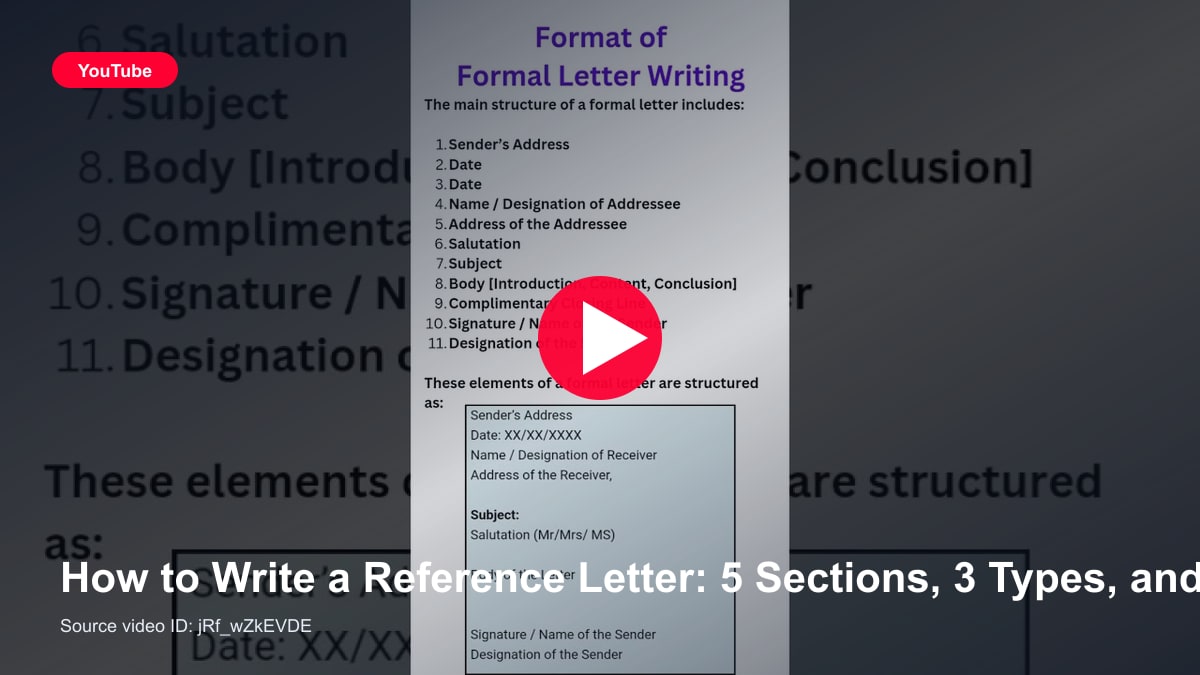
A reference letter uses formal business letter format: single-spaced paragraphs, one blank line between sections, a 12-point professional font such as Arial or Times New Roman, and 2.5 cm margins on all sides. The document is saved as a PDF to preserve formatting.
The table below covers the 6 key format elements and the standard for each.
| Format Element | Standard | |—|—| | Font | Arial, Calibri, or Times New Roman | | Font size | 12 points for body, 14 points for header | | Line spacing | Single-spaced within paragraphs | | Paragraph spacing | One blank line between each paragraph | | Margins | 2.5 cm on all sides | | File format | PDF for submissions, .docx if editing is needed |
A reference letter on company letterhead increases credibility. Letterhead confirms the writer’s employer, title, and contact details without requiring a separate header block.
What Is the Ideal Length of a Reference Letter?
A reference letter is 1 page for most job applications, containing 3 to 4 paragraphs and 250 to 400 words. Academic reference letters for postgraduate programmes extend to 2 pages when publication records or research projects require detailed coverage.
A letter exceeding 1 page for a standard job application reduces readability. Hiring managers review multiple reference letters per candidate. Concise letters that deliver evidence efficiently score higher than long ones that repeat generic statements.
What Do You Include in a Reference Letter for a Job?
A reference letter for a job includes the candidate’s job title during the working relationship, 2 to 3 specific professional achievements, the duration of the professional relationship, and a direct recommendation for the target role.
The 6 elements that increase a reference letter’s impact:
- Duration: State exactly how long you worked with the candidate. Examples include “3 years,” “from 2021 to 2024,” and “across 2 project cycles.”
- Job title: Name the position the candidate held under your supervision.
- Measurable achievements: Include numeric outcomes. Examples include revenue figures, team sizes, completion rates, and percentage improvements.
- Specific skills: Name skills relevant to the role being applied for, such as stakeholder management, data analysis, or budget oversight.
- Character evidence: Describe one situation that demonstrates reliability, initiative, or leadership under pressure.
- Availability for follow-up: Confirm the writer’s willingness to answer further questions from the hiring manager.
What Are the 3 Most Common Reference Letter Mistakes?
The 3 most common reference letter mistakes are vague praise without evidence, a writer who lacks direct professional knowledge of the candidate, and a letter that does not address the target role.
These 3 errors reduce a letter’s influence at the hiring stage.
- Vague praise: Phrases such as “a great person to work with” or “always gave 100%” provide no verifiable evidence. Every statement requires a specific example.
- Wrong relationship: A reference letter from a family member, personal friend, or distant acquaintance carries no professional weight. The writer requires direct supervisory or collaborative experience with the candidate.
- No role alignment: A letter that describes skills unrelated to the target role misses the hiring manager’s key requirements. The writer reviews the job description before writing and aligns examples to the listed criteria.
A 4th error appears specifically in character reference letters: describing personal qualities in place of professional ones. Statements such as “he is kind and generous” do not address employability. Character references still require examples of skills, reliability, and work-relevant behaviour.
People Also Ask About Reference Letters
Who writes a reference letter for a job? A reference letter for a job is written by a former manager, direct supervisor, senior colleague, or academic lecturer who has directly observed the candidate’s professional performance.
How many reference letters does a job application require? Most job applications request 2 to 3 reference letters. Senior-level and government positions request up to 5.
Does a reference letter need a signature? A reference letter requires a handwritten or digital signature above the writer’s printed name. An unsigned letter reduces professional credibility.
How do you ask someone to write a reference letter? A reference letter request identifies the target role, provides the job description, states the deadline, and explains why the writer’s perspective adds specific value to the application.
Is a reference letter the same as a letter of recommendation? A reference letter and a letter of recommendation serve the same function. “Reference letter” is the standard term in the United Kingdom. “Letter of recommendation” is the standard term in the United States.
What Makes a Reference Letter Effective?
An effective reference letter names a specific role, cites 2 to 3 measurable achievements, states the exact duration of the professional relationship, and closes with an unconditional endorsement. These 4 elements address the 2 factors hiring managers value most: evidence of past performance and direct knowledge of the candidate.
According to the SHRM, 96% of HR professionals conduct reference checks. The written letter is the first evidence a hiring manager receives about a candidate from a third party. A letter built on specific examples, quantified results, and a clear endorsement functions as a second CV from the perspective of someone who has already assessed the candidate in a professional setting.
The 5 sections, 1-page format, and role-specific skills evidence form the complete framework for a reference letter that supports rather than undermines a job application.
For another writing guide, see How to Write a Letter of Permission: 5 Sections, 4 Types, and Format Rules.
