
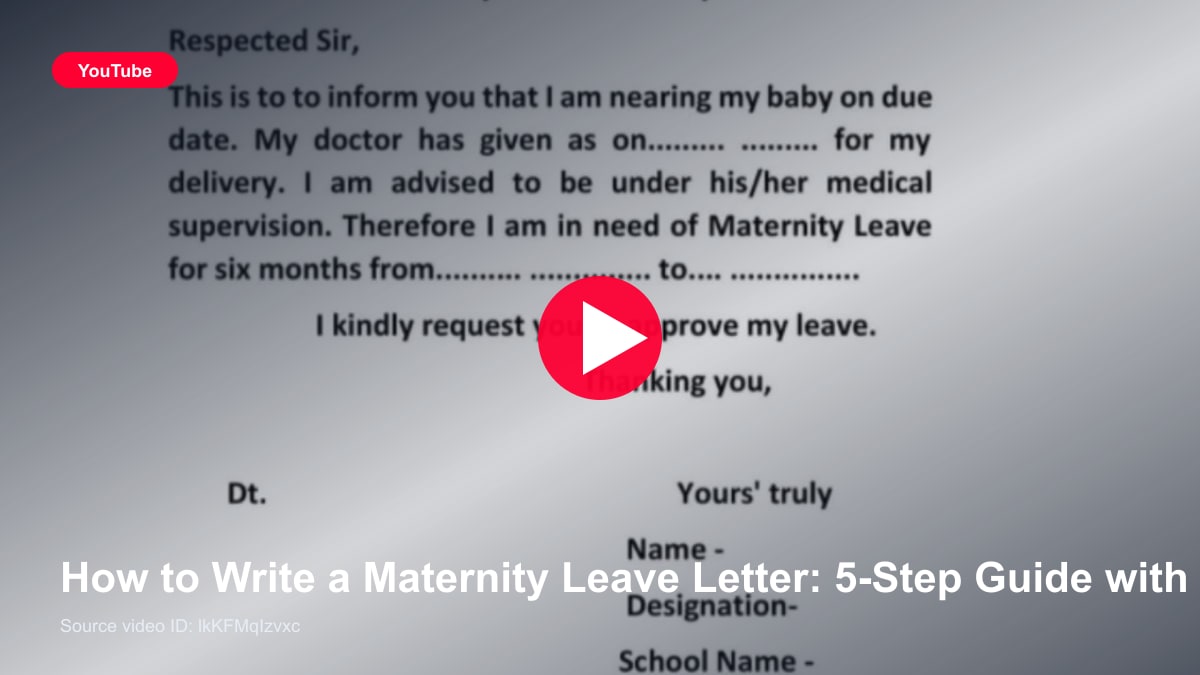
A maternity leave letter is a formal written notice sent by a pregnant employee to their employer confirming their intention to take maternity leave, the expected start date, and the planned return date. It fulfils a legal notification requirement in most countries and protects the employee’s rights to statutory pay and job reinstatement. Employers in the United Kingdom, United States, and Australia each have separate legal timelines for when this notice must be submitted.
What Is a Maternity Leave Letter?
A maternity leave letter is an official written notice that informs an employer of a pregnancy, the intended maternity leave start date, and the expected date of return. It triggers the employer’s legal obligations regarding statutory pay, health and safety adjustments, and job protection. The letter is distinct from a verbal notification, since written notice creates a dated legal record that both the employer and employee retain.
What Are the Legal Requirements for a Maternity Leave Letter?
Legal requirements for maternity leave notification differ by country, but all 3 major jurisdictions set a specific deadline for submitting written notice.
| Country | Notice Deadline | Leave Entitlement | Paid Leave | |—|—|—|—| | United Kingdom | By the 15th week before the expected week of childbirth | Up to 52 weeks | 39 weeks SMP (if eligible) | | United States (FMLA) | 30 days before leave starts | 12 weeks unpaid | No federal paid leave | | Australia | 10 weeks before leave starts | Up to 52 weeks | 18 weeks government-funded PPL |
In the United Kingdom, the Employment Rights Act 1996 requires employees to notify their employer of the expected week of childbirth (EWC) and their intended start date no later than the end of the 15th week before the EWC. Failing to meet this deadline can delay Statutory Maternity Pay. In the United States, the Family and Medical Leave Act (FMLA) applies only to companies with 50 or more employees and requires 30 days’ advance notice where practicable.
What Are the 6 Key Parts of a Maternity Leave Letter?
A maternity leave letter contains 6 parts: a header, an opening statement, a due date notification, a leave start date, a return date, and a transition plan. Each part fulfils a specific legal or practical requirement.
| Part | Purpose | |—|—| | Header | Names both parties, the date, and subject line | | Opening statement | Formally announces the pregnancy and intent to take leave | | Due date notification | States the expected week of childbirth as required by law | | Leave start date | Confirms the exact date the employee intends to begin leave | | Return date | States the planned date of return | | Transition plan | Outlines handover arrangements for ongoing responsibilities |
How Do You Write Each Section of a Maternity Leave Letter?
How Do You Start a Maternity Leave Letter?
The opening paragraph states the purpose of the letter, confirms the pregnancy, and references the relevant statutory entitlement in one to two sentences. It is addressed to the line manager or HR department by name. Using a named recipient confirms the letter has reached the correct person and creates a clear chain of receipt.
An effective opening reads: “I am writing to formally notify you of my pregnancy and my intention to take statutory maternity leave, beginning on [date]. My expected week of childbirth is [week commencing date], as confirmed by my midwife.”
What Should the Body of a Maternity Leave Letter Include?
The body of a maternity leave letter confirms the leave start date, the expected return date, and any relevant arrangements for covering responsibilities during the absence. It also states whether the employee intends to take the full statutory period or a shorter duration. Including a shorter planned leave period does not legally bind the employee to that date, since UK law permits employees to change their return date with 8 weeks’ written notice.
The body addresses 4 points in sequence:
- The confirmed leave start date.
- The expected date of return to work.
- Whether the employee plans to use annual leave before or after the maternity period.
- Any handover arrangements, including who will cover key responsibilities and where relevant documents are stored.
How Do You Close a Maternity Leave Letter?
The closing paragraph requests written confirmation of the leave arrangements and provides contact details for correspondence during the leave period if the employee is willing to receive it. It ends with a professional sign-off. Requesting written confirmation creates a second dated record that the employer has received and acknowledged the notice.
The closing reads: “I would be grateful for written confirmation of my maternity leave dates and my Statutory Maternity Pay entitlement. Please contact me if you require any further information.”
When Should You Send a Maternity Leave Letter?
Send the maternity leave letter no later than the end of the 15th week before the expected week of childbirth in the UK, or 30 days before the intended leave start date in the US. Earlier notification is always permissible and gives employers more time to arrange cover. Most HR advisers recommend sending the letter between 20 and 24 weeks of pregnancy.
The letter should be sent by email with read receipt, or by recorded post if submitted in hard copy, to create a dated delivery record.
What Are Common Mistakes in Maternity Leave Letters?
The 5 most common mistakes in maternity leave letters are: missing the legal deadline, omitting the expected week of childbirth, failing to request written confirmation, not specifying the leave start date, and sending by unrecorded means.
- Missing the legal deadline: In the UK, missing the 15th-week deadline can delay Statutory Maternity Pay. Employers are not legally required to pay SMP from the intended start date if notice is late without good reason.
- Omitting the EWC: UK law requires the expected week of childbirth in the written notice. Omitting it makes the letter legally incomplete under the Employment Rights Act 1996.
- Not requesting written confirmation: Without written confirmation, the employee has no record that the leave dates were accepted.
- No specified start date: Stating only the due date leaves the employer without the information needed to arrange cover.
- Sending by unrecorded means: A letter delivered without proof of receipt cannot be proved to have arrived on a specific date.
Maternity Leave Letter Template
UK Template
[Your Full Name] [Your Job Title] [Your Department] [Date]
[Manager’s Full Name] [Their Job Title] [Company Name] [Company Address]
Subject: Notification of Maternity Leave
Dear [Manager’s Name],
I am writing to formally notify you of my pregnancy and my intention to take statutory maternity leave. My expected week of childbirth is the week commencing [date], as confirmed by my midwife or obstetrician.
I intend to begin my maternity leave on [intended start date]. Subject to no complications arising, I plan to return to work on [planned return date], having taken [number] weeks of leave. I understand that I may change my return date by giving 8 weeks’ written notice.
To ensure a smooth handover, I will prepare a written briefing document covering my current projects and key contacts by [handover completion date]. I am happy to discuss any additional arrangements at your convenience.
I would be grateful for written confirmation of my maternity leave dates and my Statutory Maternity Pay entitlement. Please contact me at [email/phone] if you require further information.
Yours sincerely, [Full Name]
US Template (FMLA)
[Your Full Name] [Your Job Title] [Date]
[Manager’s Full Name] [Company Name] [Company Address]
Subject: FMLA Maternity Leave Request
Dear [Manager’s Name],
I am writing to formally request maternity leave under the Family and Medical Leave Act (FMLA). My expected due date is [date]. I intend to begin my leave on [start date] and plan to return to work on [return date], having taken [number] weeks of leave.
I understand that FMLA entitles eligible employees to 12 weeks of unpaid, job-protected leave for the birth of a child. I would appreciate written confirmation of my leave request and any required FMLA paperwork at your earliest convenience.
I will prepare a handover document covering my current responsibilities before my leave begins. Please contact me at [email/phone] if you need any additional information.
Sincerely, [Full Name]
What Should You Know Before Writing a Maternity Leave Letter?
A maternity leave letter must be submitted by the legal deadline in the relevant jurisdiction, include the expected date of childbirth, confirm both the leave start date and the planned return date, and request written acknowledgement from the employer. In the UK, missing the 15th-week deadline risks delaying Statutory Maternity Pay. Both the UK and US templates above create a dated legal record of notification and protect the employee’s right to return to the same or an equivalent role after leave ends.
For another writing guide, see How to Write a CV for a Job: 7 Sections, Format Rules, and ATS Tips.
