
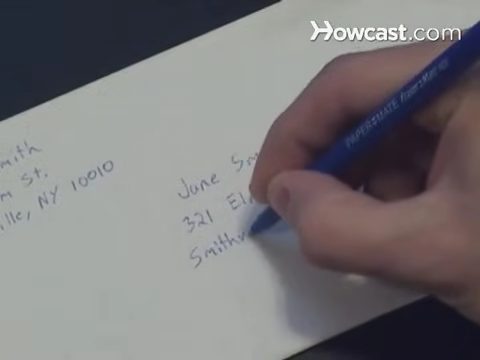
How to Write From and To on an Envelope
What Do “From” and “To” Mean on an Envelope?
On an envelope, “From” refers to the sender’s return address and “To” refers to the recipient’s delivery address.
Standard postal mail rarely prints the words “From” or “To” directly; position does that job instead, with the sender’s address in the upper-left corner and the recipient’s address in the center. Gift tags and shipping labels are the main exception, where “From:” and “To:” are often written out.
The return address tells the post office where to send the item back if it cannot be delivered. The delivery address tells the postal carrier exactly where to bring it. Both addresses follow the same three-line format, just in different positions on the envelope, and getting either position wrong is one of the most common reasons mail gets delayed or misdirected.
Where Does the “From” Address Go on an Envelope?
The “From” address, also called the return address, goes in the upper-left corner of the envelope, roughly a quarter inch from the top and left edges.
- Name of the sender on the first line.
- Company name on the next line, if applicable.
- Street address or P.O. box on the following line.
- City, state, and ZIP code on the last line.
A return address label can replace handwriting this block by hand, though formal stationery, such as wedding invitations, often keeps it handwritten to match the recipient address.
Where Does the “To” Address Go on an Envelope?
The “To” address, also called the delivery address, goes in the center of the envelope, written parallel to the longest edge so postal scanners can read it correctly.
- Full name of the recipient on the first line.
- Street address, apartment, or suite number on the next line.
- City, state, and ZIP code on the last line.
Leave the bottom edge of the envelope blank. USPS equipment prints a barcode there during processing, and writing or decorations in that space can interfere with delivery.
When mail goes to someone at another person’s address, such as a relative’s or a coworker’s, a “care of” line goes between the recipient’s name and the street address, written as “c/o” followed by the name of the person who lives there.
How Do You Address an Envelope to a Married Couple or Family?
Addressing an envelope to a couple or family follows the same center-position format, with both names on the first line or on two separate lines, depending on how much space the names need.
Traditional etiquette historically listed the husband’s name first on a shared line, such as “Mr. and Mrs. James Carter.” Many senders today order names by preference or alphabetically instead, particularly for same-sex couples or when only one partner’s name is known well. For a family, “The Carter Family” on the first line works as a general-purpose option that avoids listing every name individually.
How Do You Format the Address Lines?
Both the “From” and “To” blocks follow the same three-line structure: name, street address, then city, state, and ZIP code.
| Line | From (Sender) | To (Recipient) |
|---|---|---|
| 1 | Sender’s name | Recipient’s name |
| 2 | Street address or P.O. box | Street address, apartment, or suite number |
| 3 | City, state, ZIP code | City, state, ZIP code |
Use a P.O. box or a street address on a given line, not both. If either address includes a unit, suite, or apartment number, keep it on the same line as the street address whenever it fits.
What Formatting Rules Does USPS Recommend?
USPS recommends five formatting habits for both addresses: dark ink on a light envelope, capital letters, no punctuation, complete ZIP codes, and legible spacing.
- Use a pen, permanent marker, or printed label rather than pencil or light-colored ink, so the text stays legible through automated scanning.
- Print addresses in capital letters when handwriting them, since automated sorting equipment reads block capitals more reliably than cursive or mixed case.
- Skip commas and periods between address elements, since punctuation can confuse optical scanning equipment.
- Include the ZIP+4 code when it is available, since the extra four digits speed up automated sorting to a specific delivery route.
- Leave a visible space between the city, state, and ZIP code so each element is easy to separate at a glance.
How Do You Address an Envelope Going Overseas?
An envelope going overseas follows the same format as a domestic one, with one addition: the destination country’s name, written in English, on its own line at the bottom of the delivery address.
The return address stays in the upper-left corner in the sender’s home format. Some countries also require a customs form for anything beyond a standard letter, available online or at a post office.
What Are Common Envelope Addressing Mistakes?
The most common envelope addressing mistakes involve missing information rather than formatting errors.
- Missing or incorrect ZIP code, which is one of the most frequent causes of delivery delays.
- Address lines out of order, such as putting the city and state above the street address.
- Handwriting too small or unclear to read at a glance.
- Leaving off the return address entirely, which means undeliverable mail cannot be sent back.
- Insufficient postage, since domestic and international rates differ.
How Is a Package Addressed Differently From a Letter?
A package follows the same address layout as a letter, scaled up to fit a larger surface: delivery address centered on the largest side, return address in the upper-left area or a separate corner.
The main practical difference is space. A package label often has room for extra lines, such as a suite number or delivery instructions, that would crowd a standard envelope.
Why Does Envelope Format Matter?
Envelope format matters because postal equipment reads addresses by position, not by labels, so a return address in the wrong spot or a delivery address that is hard to scan can slow delivery or send mail to the wrong place.
Once the upper-left, center, and upper-right positions are set, the format applies to nearly any envelope, birthday card, business letter, or invitation, without needing to write the words “From” or “To” at all.
Common Questions About Writing From and To on an Envelope
Do the Words “From:” and “To:” Need to Be Written on the Envelope?
No. Standard postal mail relies on position rather than labels. Writing “From:” and “To:” is common on gift tags and some package labels, but a formal letter envelope typically omits both words.
Can the Return Address Go on the Back of the Envelope?
Yes. Some formal stationery, particularly wedding invitations, places the return address on the back flap instead of the front upper-left corner. Either position is acceptable as long as it is complete and legible.
Does a Postcard Follow the Same From and To Format?
Not exactly. A postcard has no separate front and back panel for writing, so the delivery address, return address, message, and stamp all share the same side, arranged in whatever layout the card’s printed lines allow.
What Happens if the Recipient’s ZIP Code Is Unknown?
The USPS website offers a free ZIP code lookup tool by address. Mail without a ZIP code can still be delivered, but it typically takes longer to sort.
