
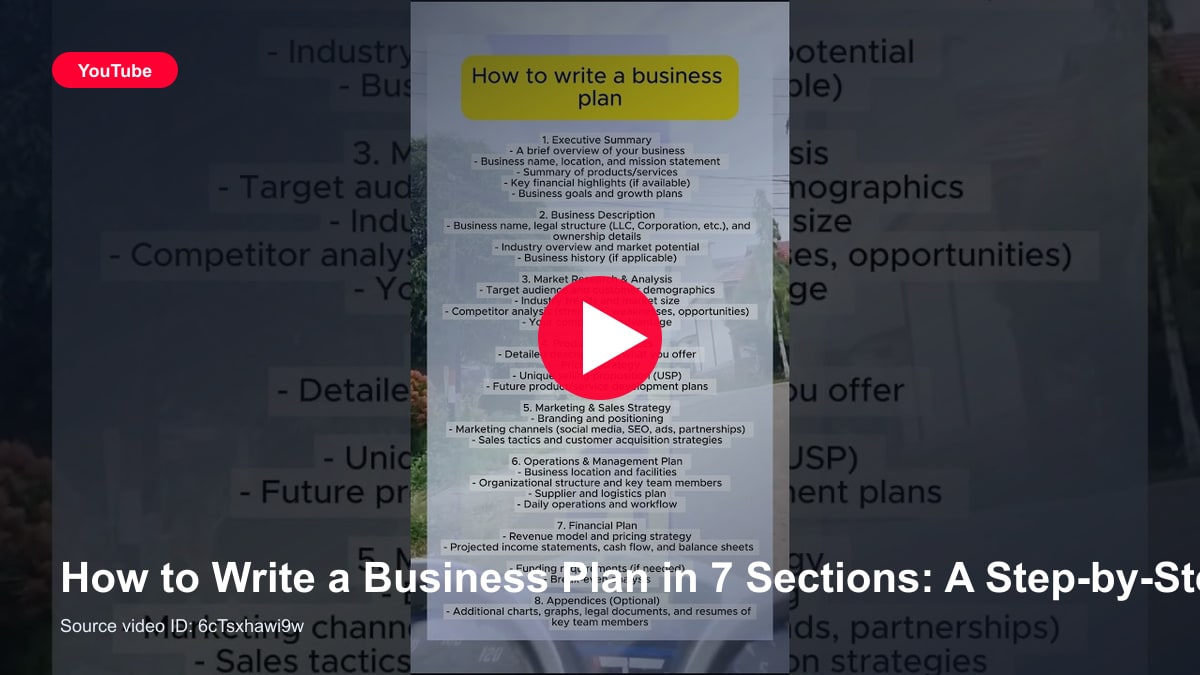
A business plan is a written document that describes how a business generates revenue, operates daily, and plans to grow. According to the U.S. Small Business Administration, it serves 2 purposes. It guides internal decision-making and convinces lenders or investors to fund the business. Most traditional business plans run 10 to 20 pages.
What Is a Business Plan?
A business plan is a structured document covering a company’s goals, market, operations, and finances. It is used by startups, small businesses, and established companies at every growth stage.
<cite index=”6-1″>A solid business plan is an essential tool for companies at all stages, from startups to mature firms.</cite> Banks, investors, and grant bodies all request one before committing capital.
What Are the 2 Types of Business Plans?
There are 2 main types of business plans. These are the traditional business plan and the lean startup business plan.
| Type | Length | Detail Level | Best For | |—|—|—|—| | Traditional | 10 to 20 pages | Comprehensive | Funding applications, lenders, investors | | Lean startup | 1 page | Key points only | Early-stage ideas, quick validation |
<cite index=”4-1″>Traditional business plans use a standard structure and encourage more details in every section. Lean startup business plans focus on summarizing the essential points of critical elements and are typically a single page.</cite>
What Are the 7 Sections of a Business Plan?
A business plan has 7 core sections. These are the executive summary, company description, market analysis, products and services, marketing and sales strategy, operations and management, and financial projections.
What Goes in an Executive Summary?
The executive summary is a 1-page overview of the entire business plan. It covers the business concept, the problem being solved, the target market, revenue model, and funding needs. <cite index=”9-1″>The executive summary is probably the most critical part of a business plan. It provides an overview of the plan as a whole and includes the company’s mission statement, products and services, and the reason behind the company’s creation.</cite>
Write the executive summary last. All other sections must be complete before summarizing them.
Key elements of an executive summary:
- Business name, location, and legal structure
- Mission statement (1 to 2 sentences)
- Products or services offered
- Target market and market size
- Revenue model
- Funding request and intended use
What Is a Company Description in a Business Plan?
The company description is a section that details what the business does, who it serves, and how it is structured. <cite index=”4-1″>It includes the company’s name, business structure, and an overview of the target market. It states whether the business is a sole proprietorship, Limited Liability Company (LLC), partnership, or corporation.</cite>
Include 4 items in the company description:
- Business name and legal structure
- Location and operational base
- History or founding story
- Core value proposition
How Do You Write a Market Analysis?
A market analysis is a data-driven review of the industry, target customers, and competitors. <cite index=”7-1″>It describes the landscape the business operates in and requires both a quantitative and qualitative analysis. The quantitative side identifies major players and their market share as a percentage of sales. The qualitative side examines what competitors offer and what gap the business fills.</cite>
Structure the market analysis using 3 market size metrics. These are Total Addressable Market (TAM), Serviceable Addressable Market (SAM), and Serviceable Obtainable Market (SOM).
| Metric | Definition | Data Source | |—|—|—| | TAM | Total global market for the product or service | Government reports, trade associations | | SAM | Portion of TAM reachable by the business model | Industry databases, competitor revenue | | SOM | Realistic market share the business captures in year 1 to 3 | Internal projections, comparable launches |
<cite index=”9-1″>Include data and statistics that break down industry trends and themes. Visualize the target audience as personas, covering what they like, their buying habits, and the services they need.</cite>
What Should the Products and Services Section Cover?
The products and services section is a detailed description of what the business sells, how it is priced, and what makes it different from competitors. <cite index=”4-1″>It covers pricing, product lifespan, benefits, and similar products from competitors. It shows the difference between the product or service and how it rises above competition.</cite>
Include these 5 elements:
- Product or service description
- Pricing and profit margin per unit
- Product lifecycle or delivery process
- Intellectual property (patents, copyrights, trademarks)
- Research and development status, if applicable
What Should the Marketing and Sales Section Include?
The marketing and sales section describes how the business attracts customers and converts them into revenue. <cite index=”3-1″>It breaks down the target market into clear buyer personas using data like age and income. It outlines the complete marketing mix, covering product positioning, pricing, distribution channels, and promotional approaches.</cite>
An example budget allocation for a marketing plan:
- 40% to paid social advertising
- 30% to influencer or partnership campaigns
- 20% to email and SMS retention
- 10% to SEO and content marketing
<cite index=”2-1″>The goal of this section is to describe how the business attracts and retains customers and how a sale actually happens. Financial projections reference this section later, so marketing and sales strategies must be described thoroughly.</cite>
What Is the Operations and Management Section?
The operations and management section is a description of how the business runs day to day and who is responsible for each function. It covers organizational structure, staffing, key roles, and supply chain relationships.
<cite index=”7-1″>It addresses how many executive, management, and employee positions exist and how departments may grow over time. It also notes external vendors and business partners, such as manufacturers and suppliers, and explains how the business fits into the supply chain.</cite>
Include a simple organizational chart. Label each role, the person filling it, and their primary responsibility. Attach CVs or resumes of key team members in the appendix.
What Financial Information Does a Business Plan Need?
The financial section requires 3 core statements and a forward-looking projection for a minimum of 3 years. These are the income statement, cash flow statement, and balance sheet.
<cite index=”9-1″>Add a report of the anticipated revenue for the coming year and the annual anticipated earnings for the next 5 years. Detail how the revenue is generated and whether any funding is needed to get started.</cite>
| Financial Document | What It Shows | Period Covered | |—|—|—| | Income statement | Revenue, expenses, and profit or loss | Monthly for year 1, annual for years 2 to 5 | | Cash flow statement | Cash in and out of the business | Monthly for year 1, quarterly for years 2 to 5 | | Balance sheet | Assets, liabilities, and equity | Annual | | Break-even analysis | Point at which revenue covers all costs | Year 1 |
For startups with no financial history, use bottom-up projections. Start from unit sales assumptions, not top-down market percentage guesses. Investors apply greater scrutiny to financial projections than any other section.
How Long Does a Business Plan Take to Write?
A traditional business plan takes 2 to 4 weeks to complete when written with proper market research. A lean startup business plan takes as little as 1 hour. <cite index=”8-1″>Most business plans are 10 to 20 pages. Shorter plans work for internal use or early-stage ideas, while investor-ready plans with financials, market research, and appendices may run longer.</cite>
What Are the Most Common Business Plan Mistakes?
There are 5 common mistakes in business plans. These are vague financial projections, an overstated market size, no competitive analysis, ignoring the operations section, and writing the executive summary first.
- Vague financials: Every revenue assumption must link to a specific activity, price, and volume number.
- Overstated TAM: Claiming 1% of a $10 billion market is not a projection. It is a guess. Break the market down to the reachable segment.
- No competitive analysis: Every market has competition. Leaving it out signals poor research.
- Skipping operations: Investors assess execution risk. A blank operations section raises it.
- Writing the executive summary first: It is a summary. Write it after every other section is complete.
What Goes in the Appendix of a Business Plan?
The appendix holds supporting documents that are too detailed for the main body. <cite index=”5-1″>It includes company brochures, resumes of key employees, lists of business equipment, copies of press articles and advertisements, pictures of the business location and products, and any applicable information about the industry.</cite> Only include documents referenced in the main sections. Keep the appendix indexed and labeled for easy navigation.
For another writing guide, see How to Write an Undertaking Letter: Format, 7 Sections, and 3 Samples.
