
How to Write a C1 Level Email: Format, Phrases, and 5 Common Mistakes
Writing an email at C1 level means matching either a formal or an informal register while staying within 220 to 260 words, the standard length for the Cambridge C1 Advanced (CAE) writing exam.
C1 sits at the “Effective Operational Proficiency” stage of the CEFR framework, one level below native-like mastery, so examiners expect controlled organisation, a wide vocabulary range, and consistent tone throughout. Getting the format and register right counts for as much of the score as the ideas themselves.
What Does C1 Level Mean for Email Writing?
C1 is the fifth of six levels in the Common European Framework of Reference for Languages (CEFR), sitting between B2 (Upper Intermediate) and C2 (Mastery). At C1, a writer can produce clear, well-structured text on complex subjects, using connectors and cohesive devices with control rather than guesswork.
The table below shows how C1 lines up against major English exams, since an email or letter task appears in most of them under a different name.
| CEFR Level | Cambridge Exam | IELTS | TOEFL iBT | TOEIC |
|---|---|---|---|---|
| C1 | C1 Advanced (CAE) | 6.5 to 7 | 95+ | 945+ |
| C2 | C2 Proficiency (CPE) | 7.5+ | Not applicable | Not applicable |
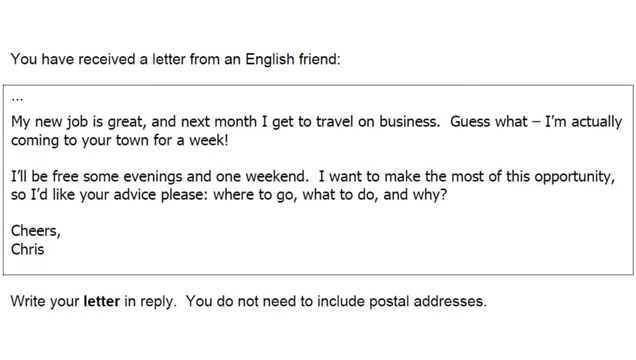
In the Cambridge C1 Advanced exam, an email or letter appears in Part 2 of the Writing paper alongside a report, review, or proposal, and candidates choose one option to complete.
What Are the Two Types of C1 Emails?
A C1 email falls into one of two registers, formal or informal, and mixing the two is one of the fastest ways to lose marks. The choice depends entirely on who the email addresses, which the exam question always states directly.
A formal email goes to someone in authority, like a company manager, an editor, or an institution the writer doesn’t know personally. An informal email goes to a friend, relative, or someone the writer already knows well. The table below compares how each register handles language, tone, and structure.
| Feature | Formal Email | Informal Email |
|---|---|---|
| Greeting | Dear Sir or Madam, / Dear Mr. Smith, | Hi Sarah, / Dear Sarah, |
| Contractions | Avoided | Used freely |
| Vocabulary | Sophisticated, Latin-origin verbs | Phrasal verbs, idioms |
| Tone | Impersonal, objective | Warm, personal |
| Sign-off | Yours faithfully / Yours sincerely | Take care / All the best |
(Image suggestion: side-by-side comparison graphic of formal and informal email structure. Alt text: “Comparison chart of formal and informal C1 email structure.”)
How Do You Structure a Formal C1 Email?
A formal C1 email follows four parts: a formal greeting, an introductory paragraph, two or three body paragraphs, and a closing paragraph. Follow these steps to build one.
- Write a formal greeting. Use “Dear Sir or Madam,” when the recipient’s name is unknown, or “Dear Mr./Ms. [Surname],” when it is given.
- Open with the reason for writing. State the purpose in one or two sentences, without small talk.
- Develop the body paragraphs. Cover one task point per paragraph, using specific, objective details rather than vague statements.
- Close with a summary. Restate the request or expectation and thank the recipient for their time.
The sign-off must match the greeting. “Dear Sir or Madam,” pairs with “Yours faithfully,” while a named greeting pairs with “Yours sincerely.”
How Do You Structure an Informal C1 Email?
An informal C1 email follows the same four-part shape, but each part carries a friendlier tone.
- Write an initial greeting. Use “Hi [Name],” or “Dear [Name],” depending on how close the relationship is.
- Open with a reaction. Respond to the friend’s news or explain why you’re writing, in a conversational tone.
- Develop the body paragraphs. Cover each task point with personal opinions, reasons, or short anecdotes.
- Close with a reason to sign off. Mention future contact, like a planned visit or a call, before the sign-off.
Even in an informal email, organisation still matters. Examiners reward emails that read clearly paragraph by paragraph, not ones that read like a stream of consciousness.
What Phrases Should You Use in a Formal C1 Email?
A formal C1 email relies on a small set of fixed phrases for the introduction, body, and closing. Useful examples include:
- I am writing to inquire about… / I am writing with regard to…
- I would be grateful if you could…
- Furthermore, / In addition, / Moreover,
- I look forward to hearing from you.
- Please do not hesitate to contact me should you require further information.
These phrases work as set expressions. Reusing them accurately scores better than inventing new phrasing that risks a grammar error.
What Phrases Should You Use in an Informal C1 Email?
An informal C1 email uses more relaxed, idiomatic phrasing throughout. Useful examples include:
- Thanks for your email, it was great to hear from you.
- Guess what? / You’ll never believe what happened.
- If I were you, I’d…
- Anyway, I’d better get going.
- Write back soon and let me know how it goes.
Phrasal verbs and idioms belong here, but the vocabulary should still show C1-level range rather than defaulting to simpler B1 phrasing.
How Long Should a C1 Email Be?
A C1 email runs between 220 and 260 words, the standard length for Part 2 of the Cambridge C1 Advanced Writing paper. Candidates get 1 hour and 30 minutes to complete both writing tasks, which leaves roughly 40 minutes for the email or letter option after planning and the compulsory essay.
Going over 260 words often introduces repetition and errors, while staying under 220 usually means a missing task point. Examiners do not penalize word count directly, but both extremes tend to lower the content and language scores together.
What Are Common Mistakes in C1 Email Writing?
Five mistakes account for most of the marks lost on C1 email tasks.
- Mixing registers. Opening with “Hi mate” and closing with “Yours sincerely” confuses the reader and signals a lack of control over tone.
- Missing task points. Every C1 email question specifies 3 points to cover, and skipping even one caps the content score.
- Playing it safe. Using only simple vocabulary and grammar avoids errors but also avoids the complexity C1 requires.
- Writing the wrong text type. Producing a report when the task calls for an email, or vice versa, loses marks regardless of language quality.
- Ignoring the word count. Going well past 260 words often introduces new errors, while stopping before 220 words usually means an incomplete answer.
Reviewing a checklist against these five points before submitting an email catches most of them.
(Image suggestion: checklist graphic listing the 5 common mistakes. Alt text: “Checklist of common C1 email writing mistakes to avoid.”)
How Is a C1 Email Graded?
Cambridge examiners score a C1 email against four equally weighted categories: content, communicative achievement, organisation, and language. Each measures a different part of the writing.
Content asks whether the email covers all 3 required points with relevant, specific detail. Communicative achievement asks whether the register and conventions suit a formal or informal reader. Organisation asks whether paragraphs and linking words guide the reader logically from start to finish. Language asks whether vocabulary and grammar show a wide, accurate range rather than a narrow, safe one.
A top-scoring C1 email typically lands between 180 and 210 on the Cambridge English Scale, with scores above 200 signaling C2-level performance.
Frequently Asked Questions About Writing a C1 Email
Can I use contractions in a C1 email?
Contractions are expected in an informal C1 email but should be avoided in a formal one, since they weaken the impersonal tone examiners look for.
How do I know if an email should be formal or informal?
The exam question always identifies the reader. A friend, relative, or close colleague calls for an informal register, while an unfamiliar authority figure calls for a formal one.
Is a dictionary allowed during the exam?
No. Cambridge C1 Advanced candidates write without a dictionary, so useful phrases need to be memorized in advance rather than looked up.
What happens if I write the wrong text type?
Writing an email when the task asks for a report, or vice versa, loses marks even if the language is accurate, since examiners grade against the conventions of the requested text type.
Is Your Email Ready for the C1 Level?
A C1 email succeeds when the register stays consistent from greeting to sign-off, every task point gets a specific answer, and the word count lands between 220 and 260. A formal email needs distance and precision, while an informal email needs warmth and natural phrasing, but both need the same four-paragraph structure underneath.
Practicing both registers separately, rather than treating them as the same skill, builds the flexibility examiners reward at the C1 level.
