
SEO Title: How to Write a Letter of Permission: 5 Sections, 4 Types, and Format Rules Meta Description: Write a letter of permission in 5 sections: sender details, subject line, reason for request, date range, and closing statement, with format rules and 4 type-specific templates.
A letter of permission requires 5 sections: sender details, subject line, reason for request, date range, and closing statement. According to SHRM’s 2024 Employee Benefits Survey, 81% of HR leaders rate leave benefits as “very important” or “extremely important.” A correctly structured permission letter increases the probability of approval and creates an official record for both parties.
What Is a Letter of Permission?
A letter of permission is a formal written request that seeks authorisation from a supervisor, institution, or authority to undertake an activity, access a resource, or take time away from a scheduled commitment. Examples include workplace leave requests, school absence letters, travel consent forms, and parental permission letters for school trips.
A permission letter serves 3 purposes. It creates a written record for both the requester and the authority. It confirms the dates, reasons, and scope of the request. It establishes accountability for both parties once approved.
What Is the Difference Between a Letter of Permission and an Authorization Letter?
A letter of permission requests approval from an authority. An authorization letter grants permission on behalf of the writer to a third party. The 2 documents serve opposite directions of communication.
A parent writing to a school to request leave for a child writes a letter of permission. A parent writing to allow a teacher to take their child on a school trip writes an authorization letter. The requesting party writes a permission letter. The approving party writes an authorization letter.
What Are the 4 Types of Letters of Permission?
The 4 types of letters of permission are workplace leave letters, school absence letters, travel permission letters, and parental consent letters. Each type addresses a different authority and requires specific content.
The table below defines each type, the writer, the recipient, and the primary content requirement.
| Type | Writer | Recipient | Primary Requirement | |—|—|—|—| | Workplace leave letter | Employee | Manager or HR department | Exact leave dates, reason, and work handover plan | | School absence letter | Student or parent | Class teacher or principal | Absence dates, reason, and academic catch-up commitment | | Travel permission letter | Employee or parent | Employer or school authority | Travel dates, destination, and return-to-work or school date | | Parental consent letter | Parent or guardian | School, sports club, or tour organiser | Child’s full name, supervising adult, destination, and emergency contacts |
Mental health-related leave requests rose 47%, according to Personio’s 2024 workplace trends data. A clearly structured workplace permission letter reduces processing delays and provides HR teams with the documentation required for compliance.
What Are the 5 Sections of a Letter of Permission?
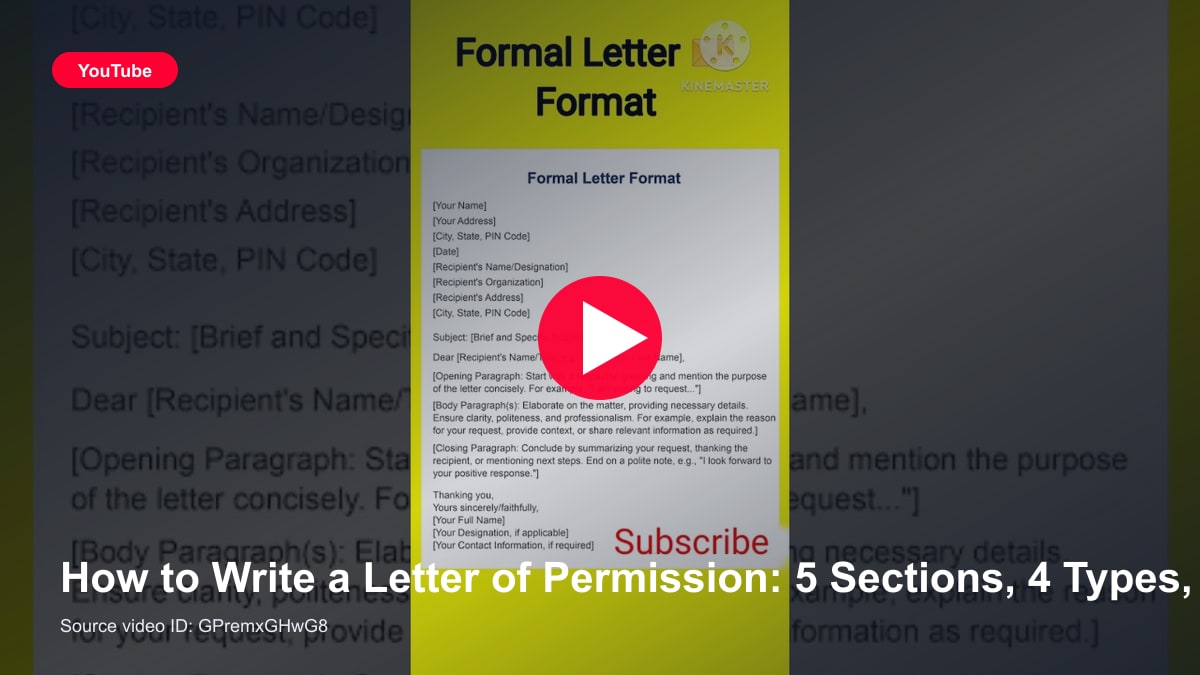
A letter of permission contains 5 sections: sender details, subject line, reason for request, specific dates and scope, and a formal closing statement. These 5 sections follow the structure that managers, school administrators, and HR departments process most efficiently.
The 5 sections in order:
- Sender details: Full name, job title or class, department or grade, contact number, email address, and the date of writing.
- Subject line: A one-line statement that identifies the request type and dates. Examples include “Leave Request: 14 to 18 July 2026” and “Permission to Attend School Trip on 22 August 2026.”
- Reason for request: A concise 2 to 3 sentence explanation of why the permission is needed. The explanation focuses on the relevant facts without unnecessary personal detail.
- Specific dates and scope: The exact start date, end date, return date, and any conditions such as task delegation, academic catch-up, or contact availability during the absence.
- Closing statement: A polite, direct sentence that invites the recipient to approve the request and confirms the writer’s availability to provide further information.
How Do You Write a Subject Line for a Letter of Permission?
A subject line for a letter of permission states the request type, the name of the person requesting, and the dates in a single line under 15 words. A specific subject line allows the recipient to log and process the request without reading the full body first.
3 examples of effective subject lines:
- “Leave Request: James Adeyemi, Sales Department, 21 to 25 July 2026”
- “School Absence: Amara Okafor, Class 8B, 10 August 2026”
- “Travel Permission Request: Lagos to Abuja, 3 to 7 September 2026”
How Do You Write the Body of a Letter of Permission?
The body of a letter of permission contains 2 to 3 short paragraphs: one stating the reason, one specifying the dates and scope, and one covering the arrangements made to manage responsibilities during the absence.
The first paragraph states the reason for the request in 2 to 3 sentences. The second paragraph states the exact start date, end date, and return date. The third paragraph covers the work or academic handover plan, such as delegating tasks to a named colleague or completing assignments in advance.
How Do You Format a Letter of Permission?
A letter of permission uses formal business letter format: 12-point font, single-spaced paragraphs, one blank line between sections, 2.5 cm margins, and a handwritten or digital signature at the close. It is addressed directly to the named decision-maker, not to a generic title.
The table below covers 6 format elements and the standard for each.
| Format Element | Standard | |—|—| | Font | Arial, Calibri, or Times New Roman | | Font size | 12 points for body text | | Line spacing | Single-spaced within paragraphs | | Paragraph spacing | One blank line between each paragraph | | Length | 1 page, 150 to 300 words | | Salutation | “Dear Mr/Ms [Surname]” or “Dear [Full Name]” |
A letter of permission submitted at least 2 weeks in advance of the requested date receives faster processing than last-minute requests. According to U.S. News, HR professionals and managers consistently identify advance notice as a key factor in leave approval decisions.
What Is the Ideal Length of a Letter of Permission?
A letter of permission is 1 page, containing 150 to 300 words across 3 to 4 short paragraphs. Parental consent letters for school trips extend to 2 short paragraphs when emergency contacts and supervisory adults require separate documentation.
A concise letter respects the recipient’s time and communicates the request clearly. Lengthy letters that include unnecessary personal context slow down processing and reduce approval efficiency.
What Do You Include in a Workplace Permission Letter?
A workplace permission letter includes the employee’s full name, department, employee ID where required, exact leave dates, reason for absence, return-to-work date, and a named colleague assigned to manage outstanding tasks. These elements satisfy the documentation requirements of most HR compliance frameworks.
The 6 elements that increase approval rates in workplace permission letters:
- Exact dates: State the first day of absence, the last day of absence, and the first day of return as separate items.
- Clear reason: State the reason in 1 to 2 sentences without excessive personal detail.
- Task coverage: Name the colleague covering your responsibilities and confirm the handover plan.
- Advance submission: Submit at least 10 working days before the requested leave start date.
- Contact availability: Confirm whether you are reachable during the absence for urgent matters.
- Reference to policy: Mention the applicable leave policy by name where known. Examples include annual leave entitlement, medical leave, and parental leave.
What Do You Include in a School Permission Letter?
A school permission letter includes the student’s full name, class or year group, the dates of absence, the reason for absence, and a commitment to complete missed coursework. Parental permission letters for school trips additionally include the parent or guardian’s contact number and a statement confirming awareness of the trip’s terms.
The 4 elements specific to parental consent letters for school trips:
- Student’s legal name: Use the name on the school register, not a shortened or informal version.
- Supervising adult: Name the teacher, coach, or authorised adult responsible for the child during the trip.
- Emergency contact: Provide a direct phone number reachable during the trip dates.
- Medical information: Note any relevant medical conditions or allergies the supervising adult requires.
What Are the 3 Most Common Letter of Permission Mistakes?
The 3 most common mistakes in a letter of permission are missing specific dates, no handover plan for responsibilities, and submitting the request too close to the absence date. These 3 errors are the primary causes of delayed or declined requests.
- Missing dates: A request that states “next week” or “for a few days” fails to provide the information required for HR or administrative processing. Every request states a specific start date, end date, and return date.
- No coverage plan: A workplace request that does not name a covering colleague creates uncertainty for the manager. A school request that does not address missed lessons creates uncertainty for the teacher.
- Late submission: According to U.S. News, submitting a leave request without advance notice places undue stress on the team and signals a lack of consideration for organisational needs.
A 4th error applies to parental consent letters: using a child’s nickname instead of the legal name on record. Schools, transport operators, and border authorities require the exact legal name as it appears on identity documents.
People Also Ask About Letters of Permission
Does a letter of permission need a signature? A letter of permission requires a handwritten or digital signature. An unsigned letter lacks the confirmation required for official record-keeping in workplace and school contexts.
How far in advance is a permission letter submitted? A workplace permission letter is submitted at least 10 working days before the requested start date. A school permission letter is submitted at least 5 school days in advance.
Is a letter of permission the same as a leave application? A letter of permission and a leave application serve the same function. “Leave application” is the standard term in South Asian and West African workplaces. “Permission letter” is a broader term covering workplace, school, travel, and parental consent contexts.
Does a travel permission letter for a child require notarization? A travel permission letter for a child requires notarization when crossing international borders, according to border authority requirements in most countries. Domestic travel typically does not require notarization.
Can a letter of permission be sent by email? A letter of permission is sent by email in most workplace and school contexts. The email follows the same 5-section structure as a printed letter and includes a digital signature or typed name at the close.
What Makes a Letter of Permission Effective?
An effective letter of permission states specific dates, names the relevant authority directly, provides a clear reason in 2 sentences, covers task or academic arrangements during the absence, and closes with a direct request for approval. These 5 elements address the 3 primary needs of any decision-maker: clarity, accountability, and confidence that responsibilities are covered.
The 5-section structure, 1-page format, and advance submission timeline form the complete framework for a letter of permission that receives a timely response across workplace, school, travel, and parental consent contexts.
For another writing guide, see How to Write a Prayer Request: 4 Sections, 3 Types, and Format Rules.
